Moving for a grammar? Where the most test systems stack.
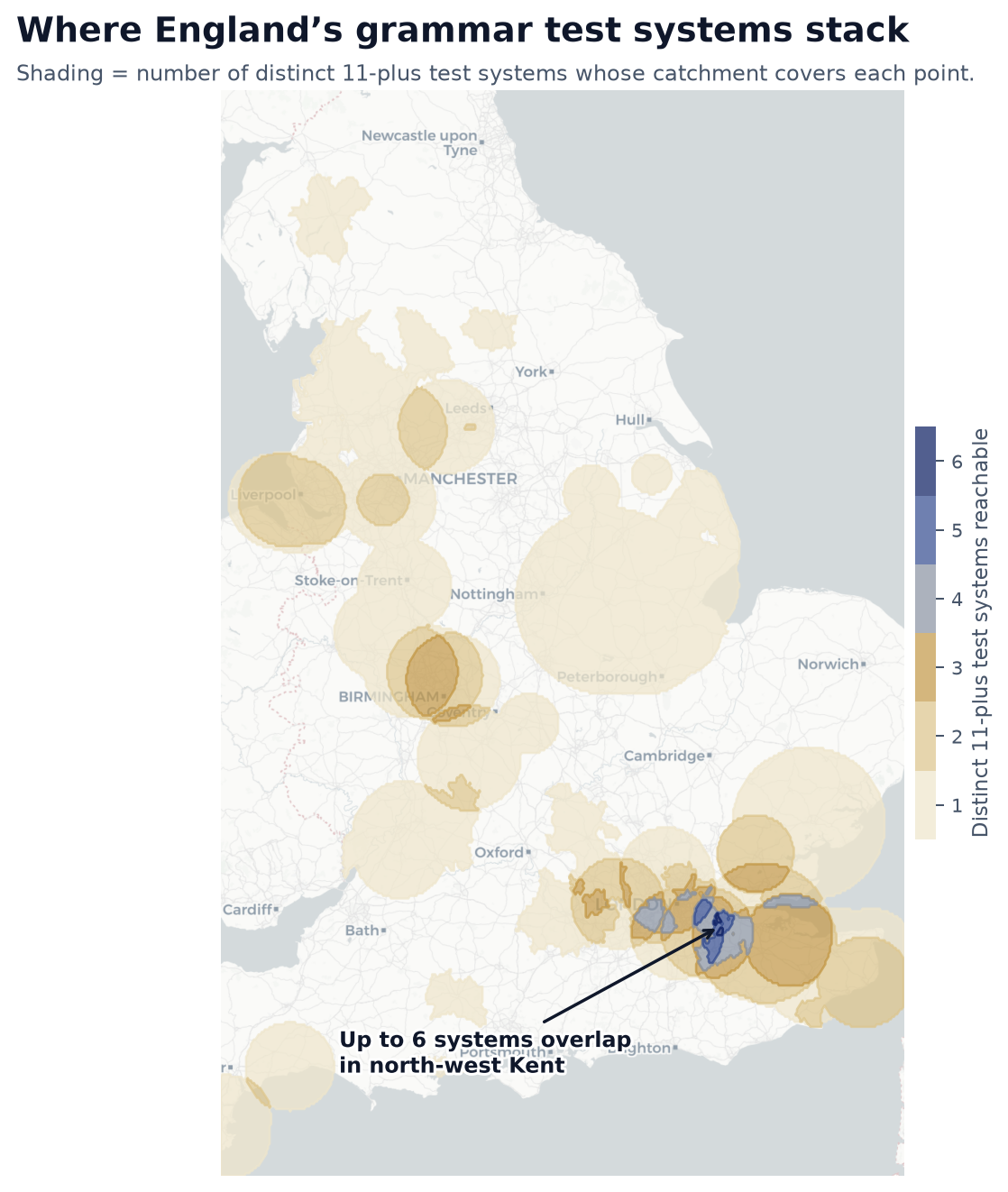
England’s grammar schools don’t share one 11-plus: they run a patchwork of separate test systems, each with its own exam, its own registration and its own deadline. Passing one buys you nothing with the next. So if you’re choosing where to live, the prize is a spot where several systems overlap, because each one is a separate, independent shot at a place. We mapped every catchment to find them. One corner of north-west Kent reaches six.
What house-hunters should know.
Every test system is a separate shot.
There is no national 11-plus. A child in Kent sits the Kent Test; in Medway, the Medway Test; in Bexley, Bexley’s own paper; and the big super-selective schools (St Olave’s, Newstead Wood, the Sutton consortium) each run their own exams on top. These are genuinely separate systems: separate registration, separate dates, separate results. A pass in one counts for nothing in another.
That changes how you should think about location. Each system your child can reach is one more independent roll of the dice: a fresh chance, uncorrelated with the others. Two systems is two shots; six is six. And whether a system is “in reach” is decided almost entirely by where you live:
- Catchment and distance schools (most of them) only consider you if you live inside their area, or close enough to clear the distance cut-off.
- Super-selective schools admit on the test score from a wide area, so they reach further, but they’re the most competitive, and a long commute is its own filter.
So we mapped the published catchment of every grammar school in England and counted, for every point on the map, how many distinct test systems cover it. The result is lumpy: most of the country sits under one system, a few areas under two or three, and one small corner under six.
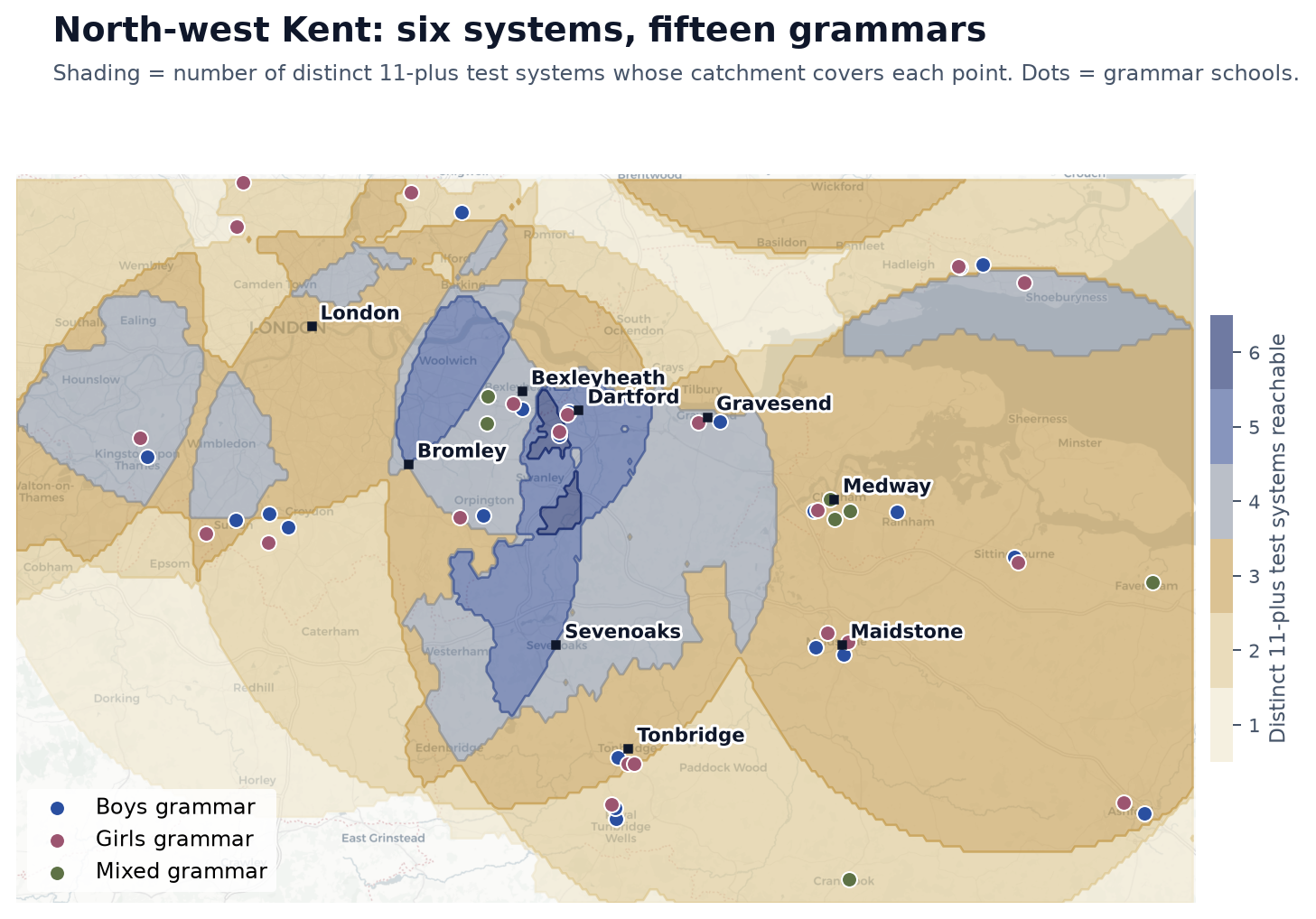
North-west Kent: six systems, fifteen grammars.
The single best-served patch in England sits around Swanley and Hextable, on the borders where Sevenoaks district meets Bromley, Bexley and Dartford. Live there and a child can, in principle, sit all six of these systems:
- the Kent Test: Dartford Grammar, Wilmington, Oakwood Park, The Judd, Tonbridge Grammar, Mayfield;
- the Medway Test: Chatham and Holcombe;
- the Bexley test: Beths and Townley;
- the Bromley super-selectives: St Olave’s and Newstead Wood, each with its own exam;
- the Sutton (SET) consortium: Wilson’s School;
- and individual schools’ own super-selective tests, sat alongside the county test.
That’s fifteen grammar schools in reach from one spot. A roll-call most counties can’t match with their whole system. The map below shades the overlap and marks each school by type.
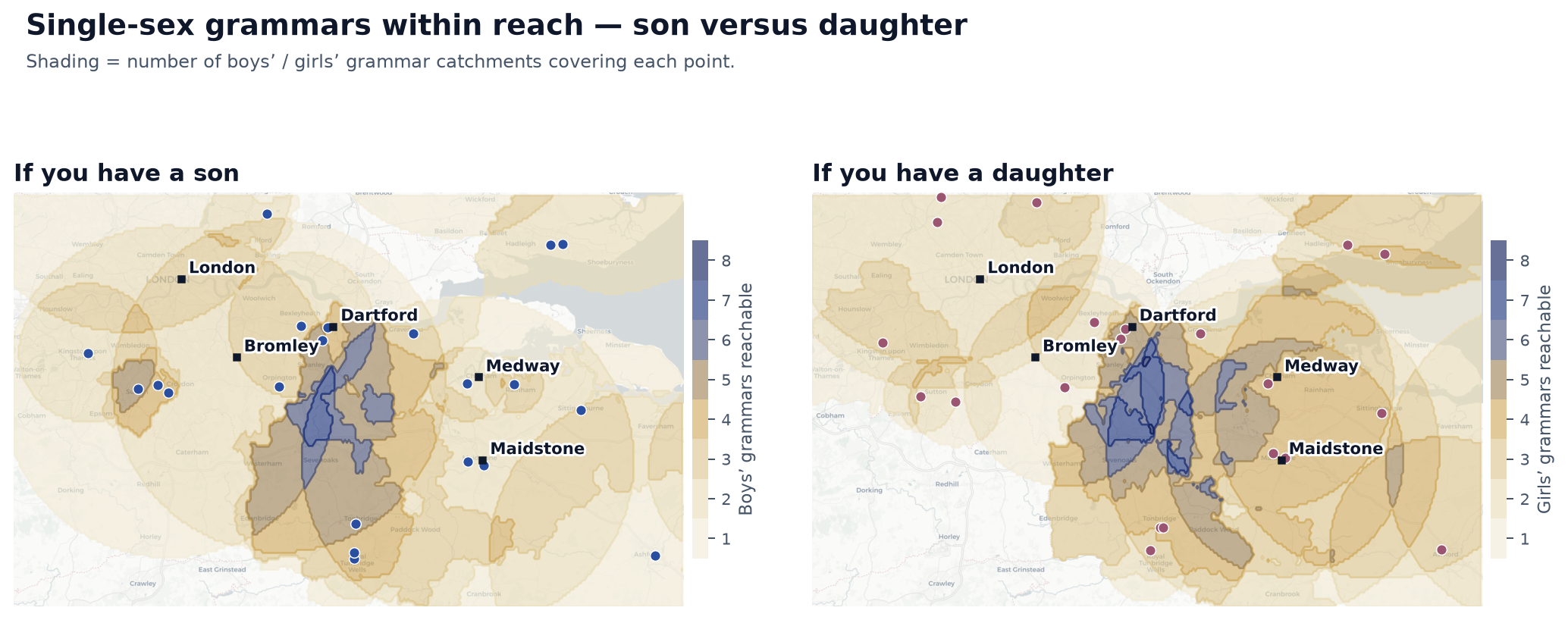
The map looks different for boys and girls.
Most grammar schools are single-sex, so the number actually open to your child depends on whether you have a son or a daughter, and the two maps don’t line up. At the north-west Kent hotspot it’s close: seven boys’ grammars (St Olave’s, The Judd, Wilson’s, Beths, Oakwood Park, Dartford and Wilmington for boys) against six girls’ (Newstead Wood, Tonbridge Grammar, Townley, Mayfield, and the Dartford and Wilmington girls’ schools), with two mixed Medway grammars open to either.
Elsewhere the balance tips the other way: several of the runner-up areas reach more girls’ schools than boys’. If you’re house-hunting, it’s worth checking the map for the child you actually have.
Where else systems stack.
North-west Kent is the clear winner, but it isn’t the only spot worth a house-hunter’s shortlist. These are the next-best areas by number of overlapping systems and schools in reach:
| Area | Test systems | Grammars in reach | Boys | Girls |
|---|---|---|---|---|
| North-west Kent (Swanley · Dartford) | 6 | 15 | 7 | 6 |
| West London (Hounslow · Ealing) | 4 | 9 | 3 | 3 |
| South Essex (Basildon belt) | 4 | 8 | 2 | 4 |
| Medway towns (Chatham · Gillingham) | 3 | 10 | 2 | 5 |
| Mid-Kent (Maidstone · the Weald) | 3 | 11 | 3 | 4 |
| Birmingham & Solihull | 3 | 9 | 4 | 4 |
Note how Mid-Kent and the Medway towns reach more grammars than West London despite fewer distinct systems: a reminder that “most schools” and “most separate chances” aren’t the same thing. If your aim is sheer number of shots, count systems; if it’s choice of school, count schools.
How to actually use this.
Stacking is opportunity, not a guarantee. Reaching six systems means six front doors are open. You still have to pass each test and rank highly on each school’s criteria. For catchment and distance schools, being “in reach” on the map also means actually living inside the boundary, and distance cut-offs shift a little every year.
Mind the logistics. Separate systems mean separate registration windows (many open in the summer before Year 6 and close in early September) separate test dates, and sometimes travel to a test centre. Sitting five or six is a real undertaking for a ten-year-old, so most families target the two or three that best fit their child rather than all of them.
Check the child you have, at the address you’re considering. The single-sex split and the exact boundaries mean the only number that matters is the one for your postcode and your son or daughter. That’s what GrammarBound is for: drop in any address and see which catchments you fall inside, your distance to each school, the tie-break each one uses, and whether your child would be eligible.
How many grammars can your postcode reach?
See every catchment you fall inside, your distance to each school and the test each one uses.
Curious whether the schools differ in quality too? See how admissions models relate to results.
How we did this.
- Coverage. Every grammar school’s published catchment (named-area polygons, or distance areas drawn from the latest cut-off) as mapped on GrammarBound. We test every point on a fine grid against all 163 catchments (point-in-polygon).
- Test systems. Each school is tagged with the entrance test it uses; some take two (e.g. the Kent Test and their own super-selective paper). “Systems reachable” counts the distinct tests across every school whose area covers a point.
- Caveats. “In reach” means a school could consider you, not that you’d be offered a place. Super-selective schools admit on score from a wide area, so their mapped area is an approximation of a practical draw; distance cut-offs move year to year; and the analysis takes no account of how competitive each place is.