Which grammar schools are rising, and which are sliding?
A grammar school’s reputation is usually years out of date. So we took four years of GCSE results for every grammar in England and tracked where each one sits in the national rankings: 2022 to 2025. Most barely move. But a handful have climbed hundreds of places, a handful have fallen off a cliff, and there’s a quiet regional split underneath it all.
Three things the rankings show.
Why we use rank, not the raw score.
There’s a trap in reading exam trends. After 2022, national exam grading was pulled back from its pandemic-era generosity toward pre-COVID standards, so everyone’s raw scores fell. The median grammar’s Attainment 8 dropped from 74.9 in 2022 to 72.5 in 2023, not because schools got worse, but because the country re-set the grade boundaries.
So a falling raw score tells you almost nothing about a school. What does is its national rank: where it sits among all ~4,700 schools in England, recomputed every year. Rank automatically strips out nationwide grading shifts and shows only how a school moved relative to the field. That’s the measure we use throughout. Lower is better, with 1 the top school in the country.
The risers and the fallers.
A few schools have moved dramatically. Dover Grammar School for Boys climbed from 592nd in England to 184th, into the national top 200, over four years. Boston High School and Chatham & Clarendon rose sharply too. Going the other way, Skegness Grammar slid from 372nd to 893rd, and The Folkestone School for Girls dropped from 218th to 424th.
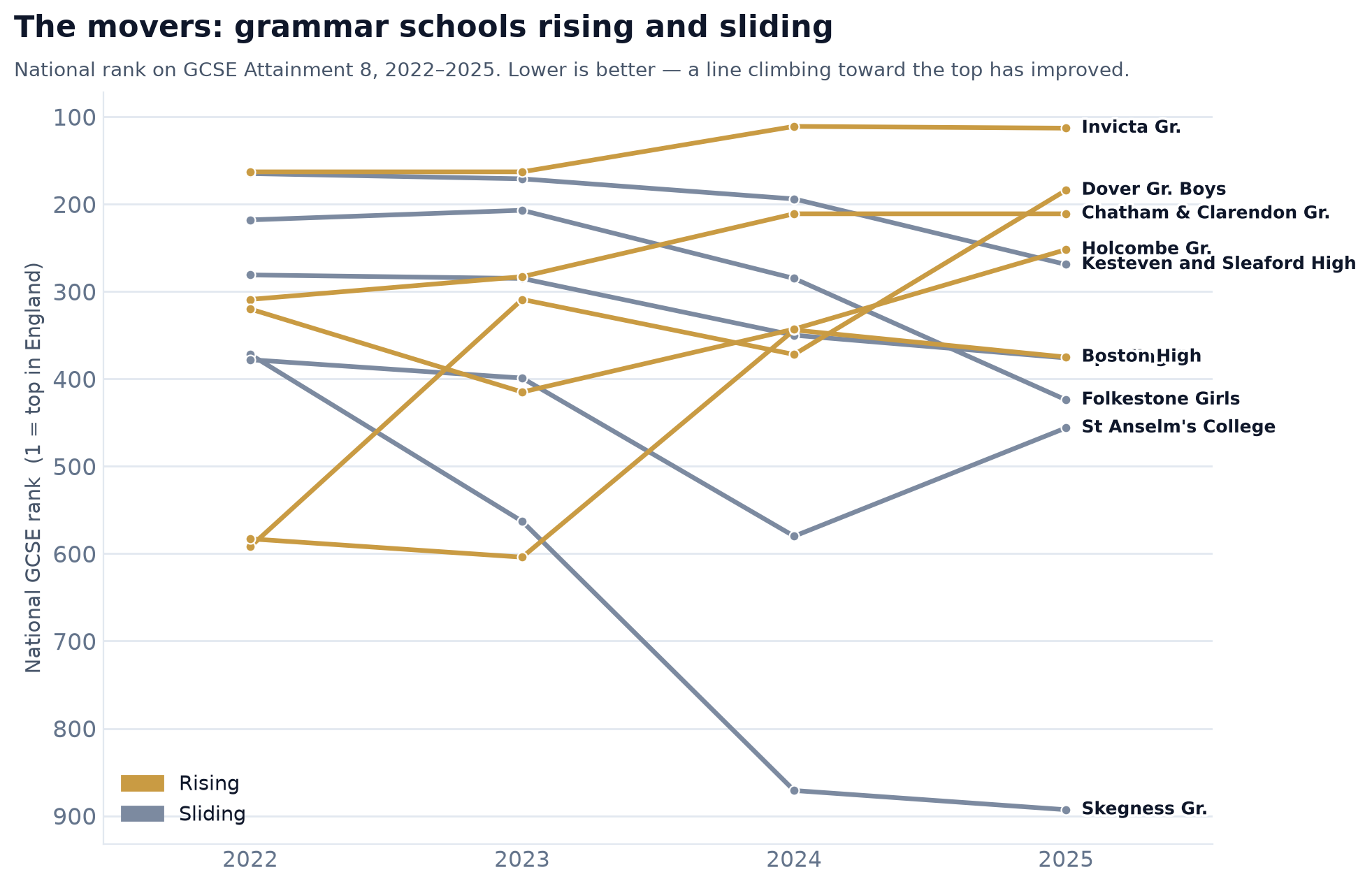
Are these moves even real?
A single year’s rank is noisy, so before believing any move we cross-check it against two other measures: the school’s A-level national rank and its Progress 8 (the value it adds for a given intake). When all three point the same way, something genuine has changed. When they disagree, it’s usually just a strong or weak cohort passing through.
Most of the headline moves hold up, and several have a clear cause:
- Dover Grammar for Boys rose on GCSE and its Progress 8 leapt from zero to +0.54. Its January 2025 Ofsted credits improved teaching “especially in mathematics”: a genuine turnaround at a school where one pupil in five is disadvantaged.
- Chatham & Clarendon climbed on GCSE, A-level and value-added together: a recovery after an earlier government warning notice.
- Skegness fell on GCSE and Progress 8 alike. It is chronically undersubscribed (admitting far fewer children than it has places) has the highest disadvantage of any grammar here, and closed its boarding house in 2021. The selective edge has simply thinned.
But two of the “sliding” lines on the chart above are false alarms. Kesteven & Sleaford High slipped on GCSE rank, yet its Progress 8 rose, and Ofsted rated it Outstanding in late 2024. St Anselm’s College “fell” on GCSE but climbed sharply at A-level. By every measure but one, both are doing fine; their dip is cohort noise, not decline.
But most grammars don’t move.
The movers make the headlines, but they’re the exception. Of 161 grammars with four years of data, 125, about 78%, shifted fewer than 30 national places. The median school moved just 13. Grammar-school standing is remarkably sticky.
And it’s stickiest at the top. The elite super-selectives sit so far up the national table, with so little room above them, that they simply can’t move much. They were near the ceiling in 2022 and they’re still there. Almost all the movement happens among mid-table grammars, ranked roughly 200th to 900th, where the national field is dense and a small change in results can swing a school by a hundred places. It’s a real effect, but it also means the dramatic-looking moves are partly a feature of how crowded the middle of the table is.
The South held; the Midlands slipped.
Average the moves by region and a pattern appears. Grammars in the South-East, London and South-West edged up against the national field; those in the East Midlands, West Midlands and North-West drifted down. The East Midlands, largely Lincolnshire, slipped 25 places on average, the clearest movement of any region.
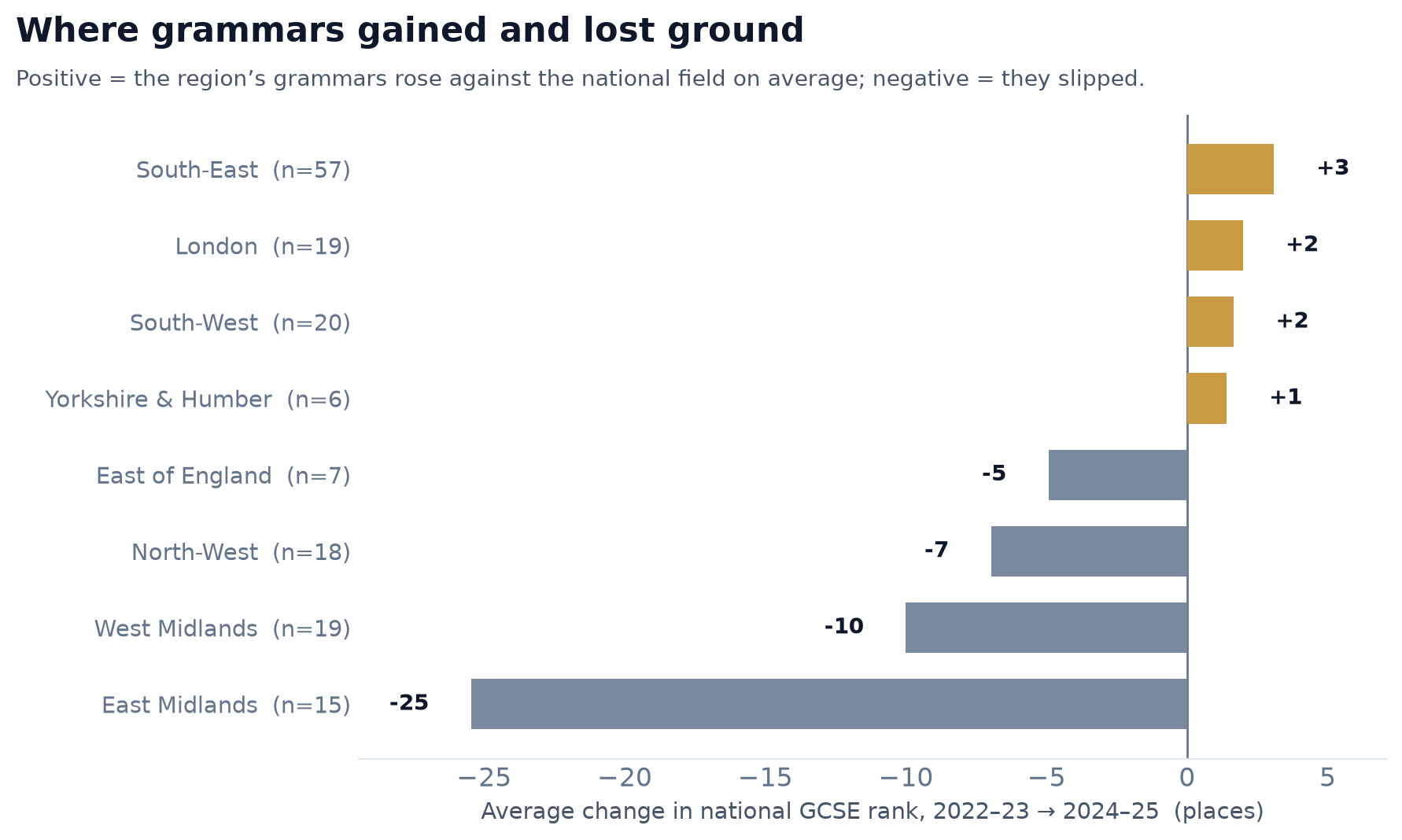
Read this carefully, though. Rank is relative. A region slipping doesn’t necessarily mean its grammars got worse; it can equally mean the rest of the country’s schools caught up. And the regional average hides real spread: Lincolnshire contains both Boston High (a top riser) and Skegness (the steepest faller). The honest reading is that Midlands and northern grammars, as a group, lost ground relative to their southern peers over these four years, not that any individual school failed its pupils.
How to use a trend.
For the top schools, the trend barely matters. A long-established super-selective will be near the top this year, next year and the year after. Its reputation is a fair guide.
For everywhere else, watch the direction, not just the level. A mid-table grammar’s single-year rank is noisy; one good or bad year can move it a hundred places. What’s meaningful is the multi-year drift: three years pointing the same way. A school quietly climbing is often a better bet than one resting on an older reputation.
And don’t be spooked by falling grades. Nearly every school’s raw results fell after 2022. If a school held its rank through that, it actually kept pace with the country.
See the full record for any school
GrammarBound shows each grammar’s four-year GCSE and A-level rankings, Ofsted history and destinations, alongside its catchment.
Or browse the national rankings, or read how admissions models relate to results.
How we did this.
- Metric. Each school’s national rank on GCSE Attainment 8, from official DfE data, for 2022, 2023, 2024 and 2025 (1 = highest of ~4,700 secondary schools). We use rank rather than the raw score so nationwide grade changes don’t masquerade as school-level trends.
- Trend. To cut single-year noise, “change” compares a school’s average rank in 2022–23 with its average in 2024–25. 161 of 163 grammars have at least three years of data.
- Caveats. Rank is most volatile in the crowded middle of the national table, so mid-table grammars swing more than top ones for the same change in results. Small cohorts add noise, and one school’s history spans a rename. Regional averages describe groups, not any single school. Progress 8 (value-added) and A-level rank are used as cross-checks on the GCSE-rank moves; Progress 8 runs only to 2024, as it is unpublished for 2025.